
Featured · TodayMystery
The Satellite Photo That Looked Exactly Like a Plane Wing
A blurry shape in a Pacific lagoon convinced researchers they had finally found Amelia Earhart's lost aircraft. A seventeen-person expedition sailed five days to find out for sure.

Listen
Read by Wren · 10 min
A Somber Man on a Sunny Beach
Rick Pettigrew stood on Nikumaroro with the lagoon behind him, his expression described by National Geographic as a stark contrast to the sunny tropical scene, and said that further investigation had confirmed the object they had sailed thousands of miles to find "does not represent the wreckage of Amelia Earhart's aircraft"5.
It was not the ending anyone on the expedition had been hoping for. Weeks earlier, the same team had called the evidence for their hypothesis "very strong"3.
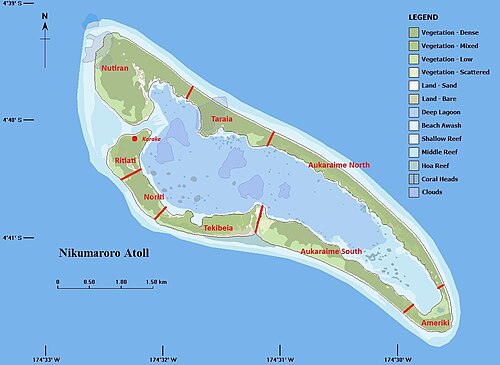
The shape that started it all first appeared in satellite imagery of Nikumaroro's lagoon in 2020, though it turned out to be visible in photography going back to 19386. Nikumaroro, once known as Gardner Island, is a remote, uninhabited coral atoll in Kiribati's Phoenix Islands, about 1,600 miles southwest of Hawaii, a place of thick scrub and Pisonia forest with almost no fresh water7. It had already been central to one of aviation's longest-running mysteries: Amelia Earhart and navigator Fred Noonan vanished on July 2, 1937, while flying from Lae, New Guinea, toward tiny Howland Island, and were never found1,8.
For nearly four decades, the International Group for Historic Aircraft Recovery, known as TIGHAR, had pushed the theory that Earhart and Noonan missed Howland, landed on Nikumaroro instead, and died there as castaways9. TIGHAR's founder, Richard Gillespie, had led repeated expeditions to the island since the 1980s, and the group's defenders and critics disagreed sharply on what, if anything, those trips had proven. A Smithsonian Air and Space Museum curator was blunt: "I don't think he's found anything on any expedition"7.
Into that long argument walked an amateur researcher named Michael Ashmore, who spotted the blurry shape on Apple Maps in 2020 and brought it to Gillespie, who was not convinced2. Ashmore then took it to Richard Pettigrew, executive director of the Archaeological Legacy Institute, who was not deterred by TIGHAR's skepticism. "I was sufficiently impressed," Pettigrew later told National Geographic. "Within a few days after that, I was already looking for ways to get back to Nikumaroro"8.
Pettigrew brought in Purdue University, which had its own stake in the story: Purdue's research foundation had originally helped finance Earhart's Lockheed Electra, which she meant to return to the school, where she had lectured, after her flight1,10. Ahead of the trip, the partners were bullish, writing that it was "very likely" the object was the remains of Earhart's plane, and sketching a three-phase plan that included eventual excavation and recovery8. On a TIGHAR forum in February 2021, one participant went further still, declaring, "This object is most likely to be the left wing of Amelia's Lockheed Electra"11.

The expedition launched from Tarawa on October 6, 2026, and spent five days sailing to Nikumaroro1. Rough seas and strong winds forced the 17-member team to spend extra time near the island before they could land, ultimately logging seven days offshore and four days ashore investigating the Taraia Peninsula1,6. They brought a magnetometer to detect ferrous metal and side-scan sonar to probe the lagoon floor, tools meant to settle the question with instruments rather than impressions from a screen2.
What they found did not match the photograph that had started everything. By the time the team reached the site, much of the material visible in the 2020 image had fragmented and washed away, leaving a single Y-shaped segment, a fraction of the object's original size4,3. The reflective quality that had first suggested metal turned out to be a carbonate veneer, the same "shiny concretized amalgam of coral sand" found coating other debris nearby3. The working explanation: large trees had come to rest on the peninsula's sandspit and later broken apart in the surf1,6,4.
The team announced its findings on October 19, 2026, local time, in a release that was carefully worded. There was "no conclusive evidence" of Earhart's aircraft, and the anomaly was "likely a collection of large trees deposited along the peninsula's sandspit"1,4. Pettigrew, who had funded the roughly $900,000 expedition with a line of credit from Purdue that he would still have to repay, insisted the trip had still done what it set out to do. "I think we accomplished our goal completely," he said. "The hypothesis has been tested, and the results are in"5.
Why Everyone Keeps Coming Back to This Island
The Nikumaroro theory did not appear out of nowhere. In September 1940, administrator Gerald Gallagher reported thirteen skeletal bones found on the island that he thought might "just possibly" belong to Earhart, though a 1941 analysis in Fiji described them as male7. A 2018 reexamination by forensic anthropologist Richard Jantz, using modern software, concluded the bones were "consistent with Earhart in all respects we know or can reasonably infer"7.
TIGHAR expeditions through the 1990s, 2000s, and 2010s turned up other period artifacts on the island: fragments of 1930s American cosmetics, a shattered compact mirror, a pocket knife, and pre-war bottles7. None of it amounted to proof the plane itself was there, and a former TIGHAR member, Martin "Monty" Fowler, later wrote that the group had become "a closed circle of true believers" that let facts become "subservient to the foregone conclusion"9.
Other searches have struck out too. Ocean explorer Robert Ballard led a 2019 expedition to search the waters around Nikumaroro for the Electra and found nothing. "We felt like if her plane was there, we would have found it pretty early in the expedition," said his chief operating officer, Allison Fundis7. A 2024 expedition separately mistook a sonar image for an aircraft before identifying it as a rock formation3.
Who Was Involved
- Amelia Earhart: American aviator who disappeared on July 2, 1937, during a round-the-world flight attempt; the Taraia Object was proposed as possible wreckage of her plane1.
- Fred Noonan: Earhart's navigator, who disappeared with her1.
- Michael Ashmore: amateur researcher who spotted the object in 2020 Apple Maps imagery and brought it first to TIGHAR, then to the Archaeological Legacy Institute8,2.
- Richard Gillespie: TIGHAR's founder and executive director, who had led decades of Nikumaroro searches but was not persuaded by the new image7,2.
- Richard Pettigrew: executive director of the Archaeological Legacy Institute, who championed the Taraia Object hypothesis and co-led the 2026 expedition8,3.
- Steve Schultz: Purdue University's general counsel, who helped bring Purdue into the expedition and co-led it with Pettigrew1,3.
The Count
- 2020: year the Taraia Object was first spotted in satellite imagery1,2.
- 17: members of the expedition team2,3.
- 5 days: sea journey from Tarawa to Nikumaroro1.
- 7 days: total time the team spent near Nikumaroro8.
- 4 days: time spent onshore investigating the Taraia Peninsula8,6.
- ~$900,000: cost of the expedition, funded by Pettigrew via a Purdue line of credit5.
- 1: the single Y-shaped fragment left of the object by the time the team arrived4,3.
Timeline
- 1937-07-02Amelia Earhart and navigator Fred Noonan disappear during their round-the-world flight attempt.
- 1940-09Thirteen bones found on Nikumaroro are speculated to possibly be Earhart's.
- 2020Michael Ashmore spots an aircraft-like anomaly in satellite imagery of Nikumaroro's lagoon, later named the Taraia Object.
- 2021-02A TIGHAR forum post declares the object is 'most likely' the left wing of Earhart's plane.
- 2026-10-06The 17-person expedition launches from Tarawa, Kiribati, toward Nikumaroro.
- 2026-10-19Purdue University and the Archaeological Legacy Institute announce the Taraia Object was likely washed-up trees, not Earhart's aircraft.
Pictures


Sources
- Search for Amelia Earhart’s plane continues after Taraia Object expedition on Nikumaroro rules out latest hypothesispurdue.edu · 2026
- Researchers Claimed a Blurry Object on Apple Maps Was 'Very Likely' Amelia Earhart's Missing Plane. It Turned Out to Be a 'Collection of Large Trees'Smithsonian Magazine · 2026
- Expedition to find Amelia Earhart's missing plane comes up emptycbsnews.com · 2026
- Expedition fails to find Amelia Earhart's plane on remote island in Western Pacificktla.com
- The 'Taraia Object' Isn’t Amelia Earhart’s Plane. So What Is It?National Geographic · 2026
- Possible wreckage of Amelia Earhart's plane likely to be trees, say researchersBBC · 2026
- NikumaroroWikipedia
- Amelia Earhart search team says object in satellite image ...lpm.org
- TIGHARWikipedia
- Amelia Earhart search: Mystery object likely trees and debrisusatoday.com
- Taraia Object decipheredtighar.org
Researched and written by Lorelet from the sources above. It cites as it goes, but it can still get things wrong, so check the sources for anything that matters.
Report a problem
More featured lorelets
See all
Today · Mystery
The Voynich Manuscript Might Have Been Bound Backward
Codebreakers have failed to read the world's most famous undeciphered book for over a century. A 2026 study asks whether anyone was ever reading it i…

Today · Space
The Moon Landing That Needs a Fuel Truck Convoy First
Before anyone sets foot near the lunar south pole again, a fleet of unmanned rockets has to pull off something no one has ever done at this scale in…

Oct 22 · History
Finding the Spot Where Photography First Saw a Person
A night out near a Paris square sent three filmmakers chasing a nearly two-century-old shadow, back to the exact patch of pavement where an anonymous…