
Featured · TodayMystery
The Voynich Manuscript Might Have Been Bound Backward
Codebreakers have failed to read the world's most famous undeciphered book for over a century. A 2026 study asks whether anyone was ever reading it in the right order.

Listen
Read by Finch · 9 min
A Booklet That Breaks Its Own Rules
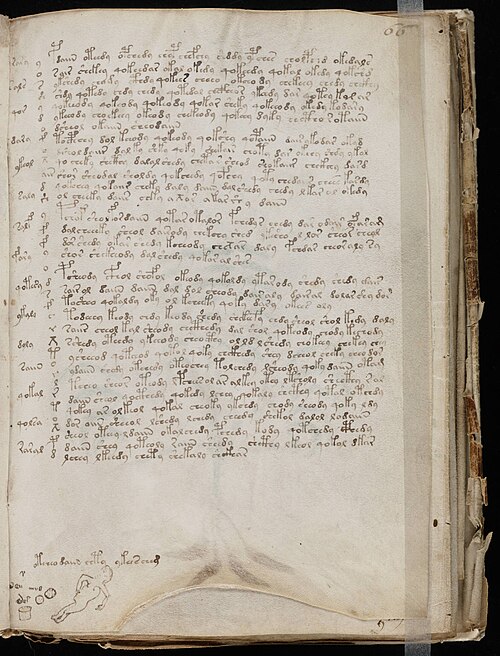
Lisa Fagin Davis had already spent years tracing the hands of five different scribes through the Voynich manuscript's pages1. Working through the manuscript's physical structure for a study published in Digital Medievalist, she and co-author Colin Layfield noticed that some of the sewn booklets making up the book, called quires, contained writing from more than one of those scribes1. "Typically a single scribe writes in a quire 'booklet,' but the current binding has different scribes in the same quire, which, to be blunt, is simply not [how it is] done," Layfield told Gizmodo1.
That is a small, dry observation about medieval bookmaking habits1. It is also the kind of detail that suggests the object in front of you is not what it appears to be1.
The Voynich manuscript is an illustrated vellum codex written in an unidentified script, now catalogued as MS 408 at Yale's Beinecke Rare Book and Manuscript Library2. It runs to roughly 240 surviving pages of plants, astronomical diagrams, nude figures in pools and channels, and pharmaceutical containers, all paired with dense lines of a script no one has read2,3. Its vellum has been radiocarbon dated to 1404-1438, which fixes the material but not necessarily the date of writing or binding2.

Its documented history is thin before the seventeenth century. The Prague scholar Johannes Marcus Marci sent it to the Jesuit polymath Athanasius Kircher in Rome in 1665, in a letter claiming the book had once belonged to Emperor Rudolf II, who allegedly paid 600 ducats for it4. From there it passed through Jesuit hands until the Polish-American book dealer Wilfrid Voynich acquired it in 1912 from the Villa Mondragone near Rome, a former Jesuit college2,4. After his death in 1930 his widow Ethel Boole Voynich kept it; the dealer Hans P. Kraus bought it from her estate in 1961 and donated it to Yale in 19694.
Long before 2026, codicologists already suspected the current page order was not the original one. They studied quire numbers, folio numbers, sewing marks, matching holes in the parchment, and even whether drawings lined up across facing pages, and found enough mismatches to argue that bifolia had been shuffled and leaves lost before the current binding was made5,6. One reconstruction proposed that leaves now scattered across the manuscript, such as f9 and f10, or f35 and f36, once sat next to each other6. None of this touched the unreadable script itself. It only said the book, as bound, did not hang together.

Davis and Layfield's 2026 study pushed that argument further than anyone had. Their claim is not just that some quires are misplaced, but that the manuscript may never have been a conventional quire-bound codex at all. They propose it was originally a stack of separate folded sheets, which they call singulions, each a self-contained four-page unit meant to be read in sequence rather than nested inside other sheets1,7,8. On their reading, a later owner or binder who could not understand the text folded and sewed those loose sheets together as if they were ordinary quires, scrambling the sequence in the process1,7.
"This means that any research that relies on the current sequence of pages needs to be revisited, since the manuscript is out of order," Davis told Gizmodo1. The study compares the Voynich manuscript's structure with known medieval books, including the Aberdeen Bestiary and the Speculum Humanae Salvationis, arguing the Voynich object behaves inconsistently with an ordinary quire structure in ways a singulion model explains better8. Reordering the leaves along those lines is reported to strengthen thematic links between adjacent pages and reconnect images that appear to continue across the gutter but are currently separated by pages that make no visual sense9,7.
None of this cracks the script. Davis herself is careful on that point: "We don't know if it's a code," she has said, while Layfield described the statistical work behind the proposal as something that merely "moves the ball" toward understanding the object7. Even if the proposed new order turns out to be right, scholars would still have to work out whether the text underneath represents a natural language, a cipher, or something else entirely. Davis has also pointed out an irony in how the book survived at all: "So few manuscripts have survived from the Middle Ages, because they weren't bound," she told the Guardian. "The irony is that whoever misbound this manuscript still did us a huge favor by ensuring its survival"1.
Inside the Binding
A codex, in the technical sense codicologists use, is built from quires: several folded sheets of parchment, nested inside one another and sewn together as a unit, usually written by a single scribe per booklet5. The Voynich manuscript as currently bound consists of 18 quires of uneven size, holding about 240 pages, though gaps in the old numbering suggest the original manuscript may have run to roughly 272 pages across 20 quires before some were lost2,5.
The parchment itself is calfskin, made from at least fourteen or fifteen whole hides, and multispectral imaging shows it was not reused from an earlier document2. Medievalist Lisa Fagin Davis has described its texture as unusually soft, the kind of softness found in books that have been "heavily thumbed," which suggests the manuscript saw regular, workmanlike use rather than ceremonial display2. The goatskin cover now on the book is not original; it dates to the period when the manuscript sat in the library of the Collegio Romano, and insect holes on the first and last leaves hint at an earlier wooden cover that has since disappeared2.
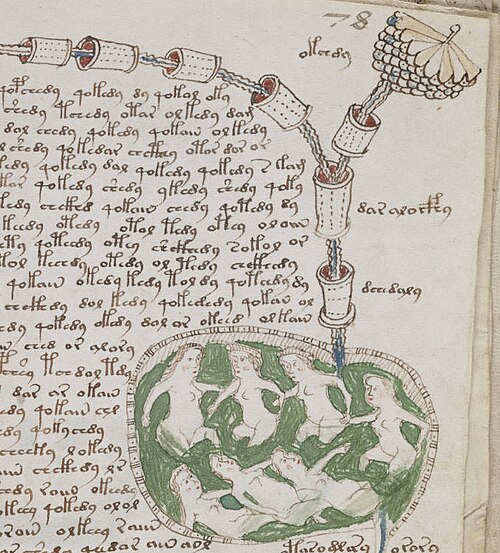
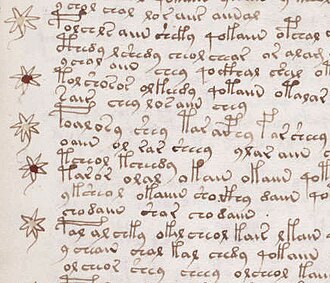
The text itself resists ordinary cryptanalysis. It runs to roughly 38,000 words built from about 170,000 characters, follows statistical patterns similar to real languages, including a Zipf's-law word-frequency curve, and different illustrated sections use noticeably different vocabulary, much as chapters on different topics would in an ordinary book2. A 2014 study from a University of São Paulo team led by Diego Amancio found the text's statistical structure matched real books in 90 percent of tested cases, arguing against the idea that it is simply random gibberish2,10. Yet the script also breaks rules every known language seems to follow, such as letters that function as grammatical markers in other languages but, in Voynichese, never show up in the middle of words2.
Who's Who
- Wilfrid Voynich: Polish-American book dealer who bought the manuscript in 1912 from the Villa Mondragone near Rome and brought it to the United States, giving it his name2,4.
- Johannes Marcus Marci: Prague scholar who sent the manuscript to Athanasius Kircher in 1665 with a letter claiming it once belonged to Emperor Rudolf II4.
- Lisa Fagin Davis: Medievalist and executive director of the Medieval Academy of America, co-author of the 2026 singulion study and earlier work identifying five scribal hands in the manuscript1.
- Colin Layfield: Information scientist at the University of Malta, co-author of the 2026 study1.
- Beinecke Rare Book & Manuscript Library, Yale University: current home of the manuscript, catalogued as MS 408, received via donation from dealer Hans P. Kraus in 19692,4.
What's Still Unresolved
The singulion theory is a recent hypothesis published in 2026, not an established consensus, and it addresses the manuscript's physical assembly, not its language1,7,8. Whether the underlying script records a natural language, a cipher, an invented language, or no meaningful content at all remains unsettled; one 2026 preprint argues the manuscript's statistical properties rule out substitution ciphers and other common explanations, concluding flatly that there is nothing in it to read, while other recent papers claim partial decipherments into vernacular Italian or propose the manuscript as an apprentice's practice document11,12,13. None of these competing claims has been independently verified or widely accepted.
The manuscript's early ownership before the seventeenth century is also unconfirmed. A proposed link to the English astrologer John Dee is disputed rather than established, and the claim that Emperor Rudolf II paid 600 ducats for the book rests entirely on Marci's 1665 letter and later provenance tradition, which cannot independently prove Rudolf owned it4. Whether reordering the manuscript along singulion lines, as Davis and Layfield propose, actually produces a coherent reading sequence is itself still being tested against the physical evidence, and the researchers stop well short of claiming it unlocks the text7,8.
Timeline
- 1404-1438Vellum used in the manuscript is later radiocarbon dated to this range2.
- 1665-08-19Johannes Marcus Marci sends the manuscript to Athanasius Kircher with a letter describing its claimed provenance through Emperor Rudolf II4.
- 1912Wilfrid Voynich acquires the manuscript from the Villa Mondragone near Rome2,4.
- 1930Wilfrid Voynich dies; his widow Ethel Boole Voynich retains the manuscript4.
- 1961Dealer Hans P. Kraus acquires the manuscript from Ethel Voynich's estate4.
- 1969Kraus donates the manuscript to Yale, where it becomes Beinecke MS 4082,4.
- 2020Lisa Fagin Davis identifies five distinct scribal hands in the manuscript1.
- 2026Davis and Layfield publish the singulion hypothesis in Digital Medievalist, proposing the manuscript was originally loose folded sheets later misbound1,7,8.
Pictures




Sources
- This Mysterious Medieval Manuscript Has Stumped Scholars for Well Over a Century. Could Its Pages Have Been Bound Out of Order This Whole Time?Smithsonian Magazine · 2026
- Voynich manuscriptWikipedia
- Voynich manuscriptdlab.epfl.ch
- Is this why the world's most mysterious text is yet to be cracked? 600-year-old Voynich manuscript may have been bound out of order, experts claim | Daily Mail Onlinedailymail.com
- 2.4 A codex with a life: quire numbers and rebinding – Instruvoinstruvo.com
- Voynich Codicology - Cipher Mysteriesciphermysteries.com
- Voynich Manuscript Was Bound in the Wrong Order, New Study Findsancient-origins.net · 2026
- We May Have Been Reading The Voynich Manuscript In ...iflscience.com
- Revealed: The Voynich Manuscript May Be Misbound, Prompting New Analysesus.headtopics.com
- Probing the statistical properties of unknown texts: application to the Voynich ManuscriptarXiv.org
- What the Voynich Manuscript Says: NothingScholarly work (preprint) · 2026
- A Key to the Voynich ManuscriptScholarly work (preprint) · 2025
- The Apprentice’s Codex: A Practical Origin Theory for the Voynich ManuscriptScholarly work (preprint) · 2025
Researched and written by Lorelet from the sources above. It cites as it goes, but it can still get things wrong, so check the sources for anything that matters.
Report a problem
More featured lorelets
See all
Today · Mystery
The Satellite Photo That Looked Exactly Like a Plane Wing
A blurry shape in a Pacific lagoon convinced researchers they had finally found Amelia Earhart's lost aircraft. A seventeen-person expedition sailed…

Today · Space
The Moon Landing That Needs a Fuel Truck Convoy First
Before anyone sets foot near the lunar south pole again, a fleet of unmanned rockets has to pull off something no one has ever done at this scale in…

Oct 22 · History
Finding the Spot Where Photography First Saw a Person
A night out near a Paris square sent three filmmakers chasing a nearly two-century-old shadow, back to the exact patch of pavement where an anonymous…