Featured · TodayHistory
Finding the Spot Where Photography First Saw a Person
A night out near a Paris square sent three filmmakers chasing a nearly two-century-old shadow, back to the exact patch of pavement where an anonymous man once stood getting his boots shined.

Listen
Read by Wren · 8 min
A Night Walk Near the Place de la République
One evening in June 2024, Maximilien Van Aertryck left a café with his colleagues Axel Danielson and Kalle Boman and crossed the Boulevard du Temple4. The trees were nearing full leaf4. Someone said, half joking, that they were pretty much standing where Daguerre's famous photograph had been taken, and that it would be funny to find the exact spot4.
They looked around a little and realized the exact place had never actually been identified or marked2,4. No one, Van Aertryck later said, not even the biggest obsessives who had studied the picture, could agree on precisely where Daguerre had taken the photograph4.
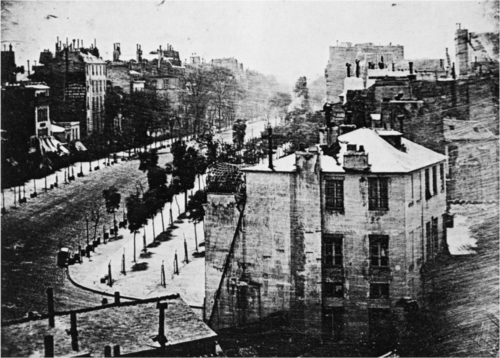
The picture in question had been taken almost two hundred years earlier, in the spring of 1838, from a window of Daguerre's own studio overlooking the boulevard1,2. Daguerre, a painter, theater designer, and inventor who had spent years refining a process for fixing an image onto a silver-coated copper plate, pointed his camera down the street and left the shutter open for several minutes1,6.

What came back was strange. The Boulevard du Temple was one of the busiest streets in Paris, lined with theaters and cafes, full of pedestrians and horse traffic5,3. But on the plate, the street looked all but empty: anything that moved during the long exposure simply failed to register1,3. The only exception, in the lower corner of the frame, was a man standing with a foot propped up while someone worked at his shoes. He had stayed still long enough to leave a faint but lasting mark, and so, probably, had the person polishing them1,7,5.
Neither man seems to have known he was being recorded. Daguerre was testing his camera on a city view, not making a portrait, and the two figures are often described as photography's first accidental sitters, caught going about an ordinary transaction on a sidewalk1,7,4. Their names were never written down anywhere, and nothing in the surviving record identifies them2,4.
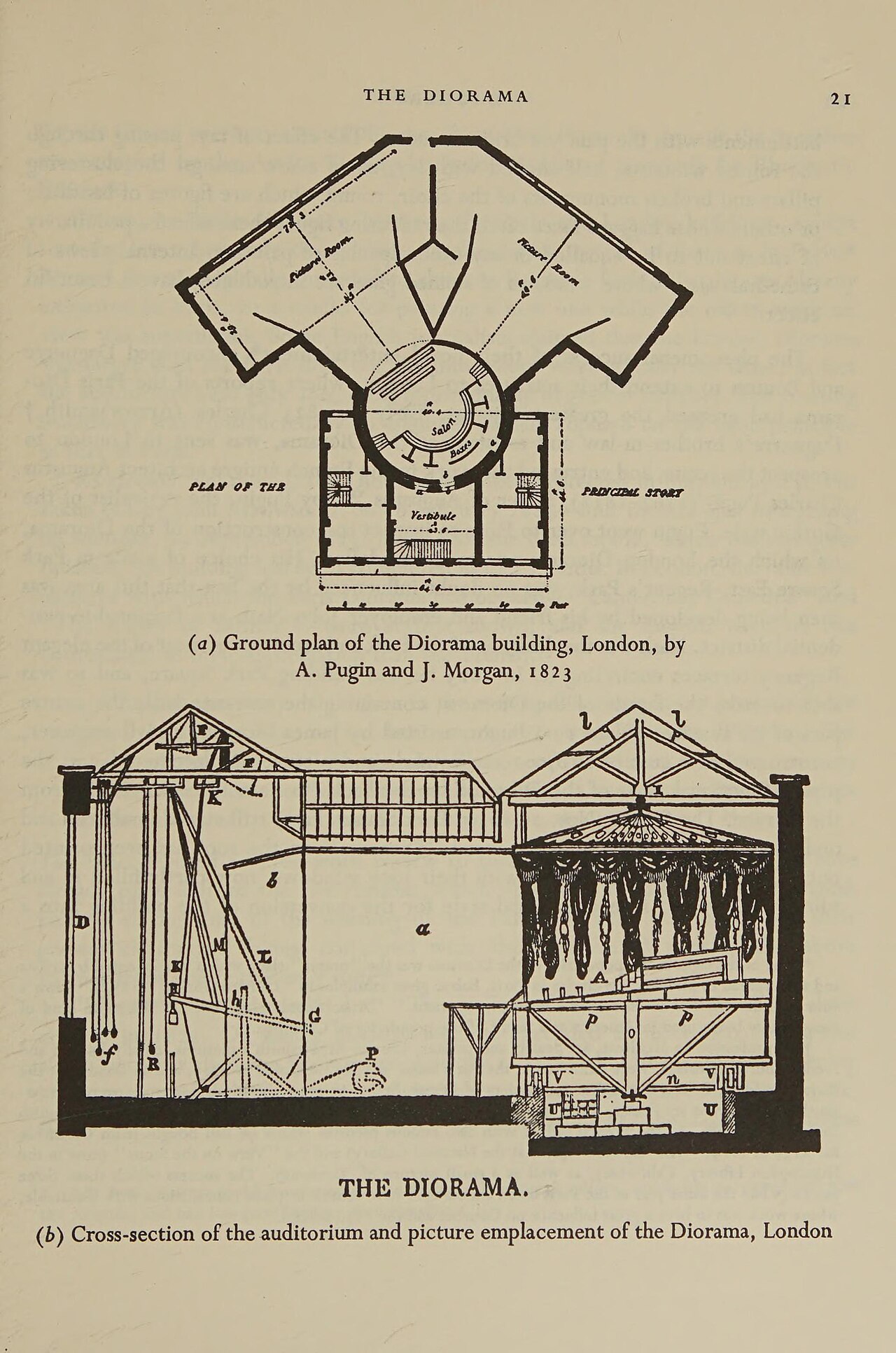
Finding them again should have been close to impossible. Daguerre's own studio and the adjoining theater he ran, the Diorama, burned down in 1839, destroying much of his paperwork1,4. Decades later, Baron Haussmann's rebuilding of Paris tore up the old street grid in that part of the city entirely, and the Boulevard du Temple as Daguerre knew it was shortened to make room for what became the Place de la République1,5. Even the plate itself had a rough afterlife: the version Daguerre gave to King Ludwig I of Bavaria survived in Munich for a century before botched restoration work during and after the Second World War left it badly damaged, so the image now mostly reproduced comes from a photograph of the original taken by the historian Beaumont Newhall in the 1930s1,4.
None of that stopped Van Aertryck, Danielson, and Boman. Over roughly two years, they combed Paris archives for maps, property and tax registers, prints, and engravings, trying to rebuild the vanished streetscape in enough detail to place a camera and a shoeshine stand on it8,2,4. Much of what they found was unhelpful, turning up the same handful of images of one building repeatedly, mainly because an emperor had once been shot there4. Eventually they identified three buildings from Daguerre's era still standing today, enough to anchor a three-dimensional model of the square against the old layout8,5,4.
They then handed their reconstruction to two separate architectural firms and asked each, independently, to work out where the shoeshine stand and Daguerre's camera must have stood5,4. The two firms came back with answers only a few feet apart, a convergence striking enough that the filmmakers simply split the difference and marked it, using nail polish borrowed in a hurry, on a paving stone in the Place de la République5,4.
On October 15, 2026, the City of Paris made that spot permanent, unveiling a bronze plaque titled "Un détail imprévu," An Unexpected Detail, set into the ground at the reconstructed location1,2. It describes the unnamed customer and the probable shoeshiner as believed to be the first human beings ever to appear in a photograph, careful wording that leaves room for the uncertainty the filmmakers never fully erased8,2.
What they solved, in the end, was a place, not a pair of lives. Van Aertryck, visiting the square afterward, scuffed his shoe over the painted X near some chewing gum on the pavement, a small mark over the precise patch of ground where, one ordinary morning in 1838, a man stood still just long enough to be seen4.
Why the Street Looked Empty
By 1838, Daguerre had already cut his exposure times down to four or five minutes, a huge improvement on the hours or days his late collaborator Nicephore Niepce had needed a decade earlier for the very first surviving camera photograph1. That was still far too slow to catch anything in motion on a crowded Paris boulevard.
The Boulevard du Temple was no quiet backstreet. It ran past theaters, cafes, and shops, and was busy enough with foot and carriage traffic that Samuel Morse, shown the image by Daguerre in person in March 1839, was reportedly astonished that none of it appeared at all1,9. Anything that kept moving for the length of the exposure simply vanished from the plate, leaving a boulevard that looks deserted even though it almost certainly was not1,3.
The customer getting his boots polished survived that erasure only because he held his pose. Analysts examining the plate have also floated other faint shapes, a child possibly looking from a window, a dog, maybe a bench with figures on it, but these remain speculative and are far less certain than the two figures at street level1,10,11.
Who's Who
- Louis Daguerre: French painter, theater designer, and inventor who developed the daguerreotype process and photographed the Boulevard du Temple from his Paris studio in 18381,6.
- The customer: an unidentified man captured standing still, apparently having his boots polished, in the lower portion of the frame; his name was never recorded1,2.
- The shoeshiner: a fainter, probable second figure working near the customer's feet; some researchers note the image is ambiguous enough that this has occasionally been read as something else, such as a water pump1,7.
- Maximilien Van Aertryck, Axel Danielson, and Kalle Boman: Swedish filmmakers who spent roughly two years, starting in 2024, reconstructing the historical location of the scene5,2,4.
- Peter von Waldthausen: researcher who in 1983 used shadow and solar-position analysis to argue the photograph was taken around May 2, 18388.
What Isn't Settled
Sources disagree on the exact year. Most accept 1838, but some place the photograph in 1837, and even the Wikipedia entry on the image hedges between the two1,12. The precise day, May 2, 1838, comes from Peter von Waldthausen's 1983 analysis of the shadow's length and direction against the sun's position, which makes it an informed estimate rather than a documented appointment8.
It is also not strictly provable that this was the very first time a living person was ever exposed on a camera plate. Hippolyte Bayard claimed to have made photographic self-portraits in 1837, though none survive, and an even earlier Daguerre image of the Pont Neuf, possibly from around 1836, may show one or two people lying on the ground1. What can be said with confidence is narrower: this is the earliest surviving photograph widely accepted to show a human being, not necessarily the first exposure ever to contain one1,13.
Finally, the Place de la République plaque itself uses the word "believed," not "proven," when describing the two figures as photography's first human subjects, a hedge that reflects both the strength of the location research and the limits of what it could actually establish8,2.
Timeline
- 1838, probably springDaguerre photographs the Boulevard du Temple from his Paris studio, producing the image later identified as showing two human figures1,2.
- January 1839Daguerre publicly announces his invention to the French Academie des Sciences1.
- March 1839A fire destroys Daguerre's studio; he shows the Boulevard du Temple image to Samuel Morse around this time1,4.
- 1983Peter von Waldthausen publishes shadow analysis estimating the photograph was taken on May 2, 18388.
- Late 19th centuryBaron Haussmann's renovation of Paris reshapes the area, erasing the old street layout and creating the Place de la République1,4.
- 2024Maximilien Van Aertryck, Axel Danielson, and Kalle Boman begin researching the exact location of the scene5,4.
- October 15, 2026Paris unveils the bronze plaque "Un detail imprevu" marking the reconstructed location on Place de la Republique1,2.
Pictures


Sources
- Boulevard du Temple (photograph)Wikipedia
- Place de la République, l’histoire de la photographie sous vos piedsmairie10.paris.fr
- https://edition.cnn.com/2014/11/06/living/oldest-photograph-human-daguerre/index.htmledition.cnn.com
- The First CandidThe New Yorker · 2026
- Where Exactly Were the First Humans to Be Captured in a Photograph Standing? Three Obsessed Filmmakers Solved the Nearly 200-Year-Old MysterySmithsonian Magazine · 2026
- Louis DaguerreWikipedia
- پرونده:Boulevard du Temple by Daguerre.jpg - ویکیپدیا، دانشنامهٔ آزادWikipedia
- The first man ever photographed: A 200-year-old mysterylemonde.fr
- January 2, 1839: First daguerrotype of the moonAmerican Physical Society · 2013
- A Second Look At The First Photo Of A HumanNPR · 2010
- A Second Look At The First Photo Of A HumanNPR · 2010
- File:Boulevard du Temple.jpg - Wikimedia Commonscommons.wikimedia.org
- File:Boulevard du Temple by Daguerre.jpg - WikipediaWikipedia
- File:Boulevard du Temple by Daguerre (unmirrored).jpg - WikipediaWikipedia
- « Un détail imprévu » fait revivre un cliché historiqueparis.fr
Researched and written by Lorelet from the sources above. It cites as it goes, but it can still get things wrong, so check the sources for anything that matters.
Report a problem
More featured lorelets
See all
Today · History
The Trawler Captain Who Sailed by a School Atlas
A Grimsby fishing boat went out for a fortnight on the Dogger Bank and did not come back. Three months later it turned up five thousand miles away, a…

Today · Art & Design
Catharina van Hemessen Paints Herself at Work
In 1548, a twenty-year-old Antwerp painter sat down at her easel and did something almost no woman before her had done on canvas: she showed herself…

Oct 21 · Art & Design
Frank Lloyd Wright's War with New York City
A museum built to house art that didn't look like anything else took sixteen years, institutional turmoil, and a small war with city hall before anyo…