Featured · TodayArt & Design
Catharina van Hemessen Paints Herself at Work
In 1548, a twenty-year-old Antwerp painter sat down at her easel and did something almost no woman before her had done on canvas: she showed herself doing the job.

Listen
Read by Wren · 8 min
A Painter Names Herself
She sits close to the easel, close enough that the viewer can see exactly what is in her hands: a palette, a bundle of brushes, and a maulstick, the rod painters used to steady their wrist on long sessions1,6. On the panel in front of her, barely begun, is the painting she is making. Her eyes are not on the viewer. They are on the work5,3. At the upper left, in small Latin letters, is a sentence that does the real work of the picture: "Ego Caterina de Hemessen me pinxi 1548 Etatis suae 20," or I, Caterina van Hemessen, painted myself in 1548, at the age of 202,3.
It is a modest object (the panel is about 32 by 25 centimeters) and an outsized claim3. Self-portraits by women were rare in the sixteenth century, and self-portraits showing an artist actually at work, mid-painting, were rarer still. Art historians treat this one as the earliest surviving example of the type, predating the famous brooding self-portraits of Rembrandt and Van Gogh by more than a century1,2,3.
Something about the claim does not quite square with the life that followed. Antwerp in 1548 ran its art trade through the Guild of Saint Luke, which controlled training, materials, and professional standing, and which rarely made room for independent women2,4. Catharina had one obvious way in: her father, Jan Sanders van Hemessen, a successful Romanist painter who trained her in his workshop from childhood2,4. That same year, he was elected dean of the guild, a position the Rijksmuseum says probably gave his daughter more room to work, though exactly what that meant in practical or legal terms is not spelled out in the record4.
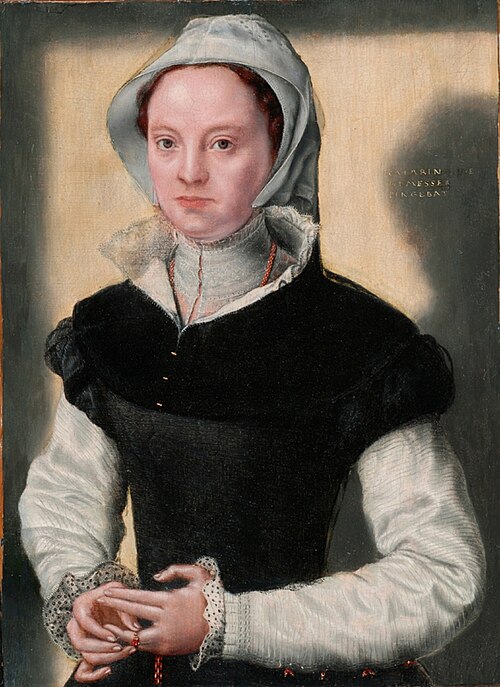
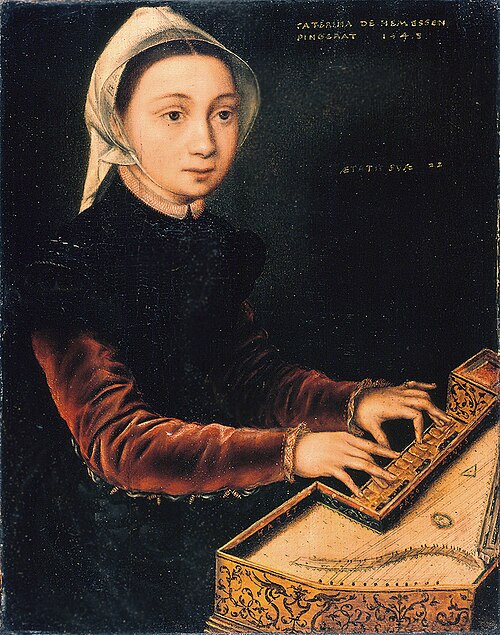
She put that room to use. Through the late 1540s and early 1550s she produced a run of small, signed and dated portraits, mostly of women, posed quietly against dark or neutral backgrounds1,7,4. She is now generally credited as the earliest Flemish woman painter whose surviving work is both signed and dated, a distinction that sets her apart from women whose paintings may have gone unattributed or absorbed into a father's or husband's name1,8.
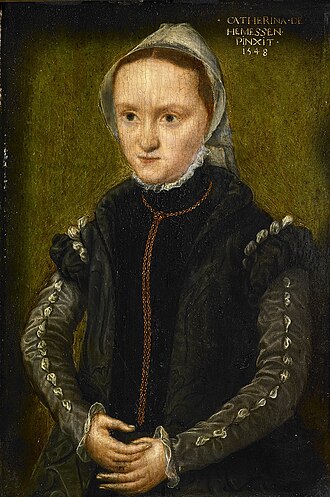
In 1554 she married Christiaan de Morien, an organist at Antwerp Cathedral, not another painter1. Two years later, the couple entered the household of Mary of Hungary, the Habsburg regent who had stepped down from governing the Netherlands and resettled in Spain1,2. It was the most prestigious posting of Catharina's documented life, proof that her work had reached the highest circles of patronage available to a Flemish artist2.
And then the record goes quiet in a specific way. No paintings survive from her years in Spain5. When Mary of Hungary died in 1558, her will and the settlement of her estate named a pension for Christiaan de Morien, not for Catharina5. Curators organizing a recent exhibition point to this as evidence against the long-standing assumption that Catharina held a formal court position at all; it is possible she worked there in some unofficial, undocumented way, or that she had already stopped painting by the time she arrived5.
She and her husband returned to the Netherlands after Mary's death, and are recorded in Antwerp by 1561, then in 's-Hertogenbosch by about 15651,5. After that, nothing certain survives. Her death is placed, depending on the source, sometime after 1565 or around 1567, pinned loosely to a line in an Italian travel writer's account describing her as still living that year1,5,4.
What endures is the panel in Basel: a twenty-year-old with a maulstick in her hand, looking past the viewer at her own unfinished work, having already written down exactly who she was and how old she was when she made it1,5,3.
Antwerp and the Guild System
Antwerp in the 1520s and 1530s was the busiest trading city in northwest Europe, and its art market grew alongside its commerce, with hundreds of painters working in the city8. Production ran through the Guild of Saint Luke, which oversaw training and set the terms for who could practice as a professional painter2,4.
Formal apprenticeship could mean years living with an established artist, often starting as early as age nine, and could include training considered inappropriate or inaccessible for women, such as the study of the nude figure1. That structure made independent careers for women extremely rare; the women who did paint were almost always trained by a close relative1.
Catharina's route in was her father's workshop. Jan Sanders van Hemessen had studied art in Italy and built a reputation in Antwerp as a leading figure of the Romanist school, artists who folded Italian influence into Flemish painting2,4. His standing in the guild, capped by his election as dean in 1548, is credited by the Rijksmuseum with giving his daughter greater latitude, even if the exact mechanics are not documented4.
Who's Who
- Catharina van Hemessen: Antwerp painter, born around 1527 or 1528, known for small signed portraits and the 1548 self-portrait at an easel1,4.
- Jan Sanders van Hemessen: Her father, a Romanist painter in Antwerp and her teacher, elected dean of the Guild of Saint Luke in 15482,4.
- Mary of Hungary: Habsburg regent of the Netherlands who retired to Spain and brought Catharina and her husband into her household in 15561,2.
- Christiaan de Morien: Organist at Antwerp Cathedral, Catharina's husband from 1554, later named in Mary of Hungary's pension records1,5.
- Guild of Saint Luke: The Antwerp painters' guild that governed training and professional practice in the city2,4.
By the Numbers
- 1548: Year the self-portrait was painted, and the year Jan Sanders van Hemessen became dean of Antwerp's Guild of Saint Luke1,4.
- 20: Catharina's stated age in the painting's Latin inscription1,5,3.
- 32 x 25 cm: Approximate dimensions of the panel3.
- 14 of 17: Works attributed to her by the National Gallery, London, of which 14 are signed, per a recent exhibition-related account7.
- 1556-1558: Years Catharina and her husband spent in the service of Mary of Hungary in Spain1,2.
What's Disputed
Sources agree on the painting's date, the inscription, and its general reputation as the earliest known self-portrait of an artist at an easel, but some caution that such firsts are hard to prove absolutely and could be overturned by an earlier example surfacing2.
Catharina's exact birth year is given as 1527 or 1528 depending on the source, and her death date is unresolved: estimates range from shortly after 1565 to around 1567, based partly on a secondhand account describing her as alive in 15671,5,4.
Whether Catharina held a formal position at Mary of Hungary's court in Spain is now actively contested. Curators behind a recent exhibition note that Mary's will and estate settlement named only Christiaan de Morien for a pension, not Catharina, and that no paintings survive from her years in Spain, raising the possibility she had already stepped back from painting or never held an official court role5.
Timeline
- c. 1527-1528Catharina van Hemessen is born in Antwerp1,4.
- 1548She paints her self-portrait at an easel, aged 20; her father is elected dean of the Guild of Saint Luke1,4.
- late 1540s-early 1550sShe produces a series of signed, dated small portraits7,4.
- 1554She marries Christiaan de Morien, an organist at Antwerp Cathedral1.
- 1556She and her husband enter the service of Mary of Hungary in Spain1,2.
- 1558Mary of Hungary dies; her estate names a pension for de Morien, not Catharina1,5.
- after 1561The couple returns to the Netherlands, later recorded in 's-Hertogenbosch1,5.
- after 1565Catharina disappears from the documented record; her death is estimated around 15671,5,4.
Pictures

Sources
- Catharina van HemessenWikipedia
- Caterina van Hemessen: An unknown visual pioneerBBC · 2021
- www.christies.com · en · storiesFive groundbreaking self-portraits by women - Christie'schristies.com
- www.rijksmuseum.nl › en › collectionCatharina van Hemessen - Rijksmuseumrijksmuseum.nl
- She Painted the First Known Self-Portrait of an Artist at Work—and Signed It—Nearly 500 Years Ago. Who Was Catharina van Hemessen?Smithsonian Magazine · 2026
- Catharina van Hemessenmauritshuis.nl
- The National Gallery to stage the first exhibition for one of Europe’s earliest women painters | Press releases archive | National Gallery, Londonnationalgallery.org.uk
- 10 things you need to know about Catharina van Hemessenrijksmuseum.nl
Researched and written by Lorelet from the sources above. It cites as it goes, but it can still get things wrong, so check the sources for anything that matters.
Report a problem
More featured lorelets
See all
Today · History
Finding the Spot Where Photography First Saw a Person
A night out near a Paris square sent three filmmakers chasing a nearly two-century-old shadow, back to the exact patch of pavement where an anonymous…

Today · History
The Trawler Captain Who Sailed by a School Atlas
A Grimsby fishing boat went out for a fortnight on the Dogger Bank and did not come back. Three months later it turned up five thousand miles away, a…

Oct 21 · Art & Design
Frank Lloyd Wright's War with New York City
A museum built to house art that didn't look like anything else took sixteen years, institutional turmoil, and a small war with city hall before anyo…