
Featured · Nov 25History
The Hollywood Ten and the Waldorf Statement
Ten men refused to answer one question before Congress. What the studios decided to do about it reshaped who got to work in American film for over a decade.

Listen
Read by Wren · 10 min
One Question, Refused
On October 27, 1947, screenwriter John Howard Lawson sat before the House Un-American Activities Committee and tried to say more than the committee wanted to hear. He told the chairman, "I am not on trial here, Mr. Chairman. This committee is on trial here before the American people. Let us get that straight"1. The committee kept narrowing him back to one question: was he, or had he ever been, a member of the Communist Party2.
Lawson would not give a direct answer, and neither would the nine men who followed him into that chair over the next several days2,3. It looked, in the moment, like a standoff between stubborn witnesses and an aggressive committee. It was also the opening move in something the witnesses could not yet see coming from inside the hearing room.
The committee's interest in Hollywood did not start that October. Communist Party membership in the United States had crested near 66,000 by 1939 and climbed back toward 50,000 during the wartime alliance with the Soviet Union, and HUAC had been circling the film industry's labor and political life for years before the big public hearings1. By 1945, Mississippi congressman John E. Rankin was calling Hollywood "the greatest hotbed of subversive activities in the United States"1, and Hollywood Reporter publisher William Wilkerson had already been running names of suspected Communist sympathizers in his column, dubbed "Billy's Blacklist"1.
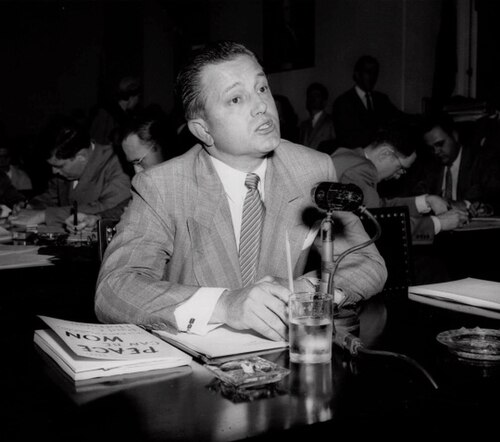
In September 1947 HUAC subpoenaed dozens of film-industry figures, drawing in part on lists like Wilkerson's1,3. The October hearings in Washington opened with friendly witnesses, including Walt Disney and Gary Cooper, testifying about Communist influence they believed they had seen in the industry1,3. Then came the eleven unfriendly witnesses, one of whom, Bertolt Brecht, answered and promptly left the country4. The other ten, including Lawson, screenwriter Dalton Trumbo, and director Edward Dmytryk, refused to answer the committee's central question and tried, mostly without success, to read statements condemning the investigation as unconstitutional1,2.

The House voted 346 to 17 on November 24, 1947, to cite the ten for contempt of Congress1. The next day, after a closed-door meeting of nearly fifty studio and industry executives at the Waldorf-Astoria Hotel in New York, Motion Picture Association of America president Eric Johnston issued what became known as the Waldorf Statement1,5. It announced that the studios would fire or suspend the ten men and refuse to rehire any of them "until such time as he is acquitted or has purged himself of contempt and declares under oath that he is not a Communist"5. It went further still, pledging that the studios would not knowingly employ any Communist or member of a group advocating the government's violent overthrow5,6.
That sequence mattered. The contempt citations were not convictions. The ten men had not yet had their day in court, let alone a final ruling, when the men who ran the studios decided, over two days in a Manhattan hotel, to exclude them from work anyway7. Eric Johnston had earlier resisted calls to make studios the enforcers of loyalty, but by the time of the Waldorf meeting he stood as the policy's public face8.
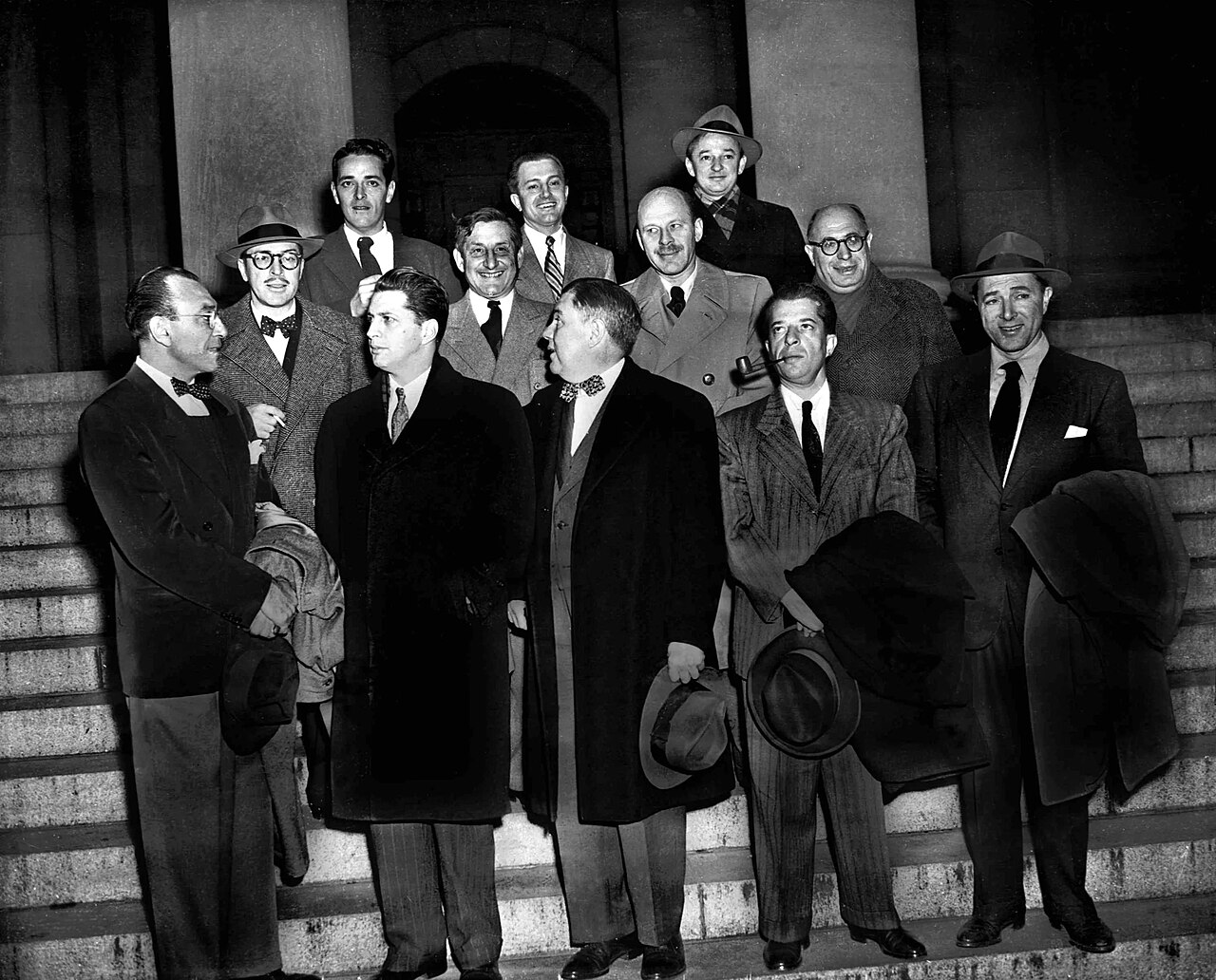
The ten men were convicted of contempt of Congress, and the Supreme Court declined to review their case in 1950, leaving the convictions, and the roughly year-long prison sentences and fines near $1,000 that came with them, in place4,7. Edward Dmytryk served his time, then returned to HUAC in 1951 and testified again, this time naming former associates, one of the sharpest breaks in the group's original solidarity9.
What began as a refusal to answer one question in a hearing room became, within weeks, a hiring policy that spread by rumor, suspicion, and informal blacklist for more than a decade, with no single master list and no clean end date1,7. The blacklist is generally considered to have weakened only in 1960, when Dalton Trumbo was openly credited for Exodus and, months later, for Spartacus1. Lawson's line to the committee, that the committee itself was on trial, did not stop the hearing from ending the way it did.
Who Was in the Room
- John Howard Lawson: Screenwriter and Screen Writers' Guild president, the first unfriendly witness called, whose clash with the committee set the pattern for the rest2.
- Dalton Trumbo: Screenwriter among the Hollywood Ten, later wrote under pseudonyms during the blacklist and was openly credited again in 19601.
- Edward Dmytryk: Director among the Ten who served prison time, then returned to HUAC in 1951 and named former associates9.
- Eric Johnston: President of the Motion Picture Association of America, initially wary of forcing studios to fire Communists, but the public spokesman for the Waldorf Statement5,8.
- Louis B. Mayer, Harry Cohn, Spyros Skouras, Nicholas Schenck, Barney Balaban, Samuel Goldwyn, Albert Warner, William Goetz, Dore Schary: studio executives named among the principal participants who formulated the Waldorf Statement5.
- J. Parnell Thomas: HUAC chairman who led the October 1947 hearings3.
What the Record Doesn't Pin Down
Accounts differ on exactly how many executives attended the Waldorf-Astoria meeting. Wikipedia's commonly cited figure is 485, but other sources describe 47 executives or approximately 50 producers10,4. The discrepancy appears to come from whether association officials, attorneys, and independent producers are counted alongside studio heads10,4.
The blacklist itself never existed as one official document. There was no single public master list of everyone excluded from film work; exclusion happened through a mix of formal studio policy and informal word of mouth about who had been named, suspected, or deemed uncooperative1,7. That makes it hard to say with precision how many careers it touched, only that it reached "hundreds" beyond the original ten1.
Timeline
- July 29, 1946Hollywood Reporter publisher William Wilkerson begins naming suspected Communist sympathizers in his column1.
- September 1947HUAC subpoenas dozens of film industry figures ahead of public hearings1,3.
- October 1947HUAC holds hearings in Washington, D.C., with friendly and unfriendly witnesses, including the eventual Hollywood Ten1,4.
- October 27, 1947John Howard Lawson's confrontational testimony sets the pattern for the other refusals2.
- November 24, 1947The House votes 346 to 17 to cite the Hollywood Ten for contempt of Congress1.
- November 24-25, 1947Roughly 48 studio executives meet behind closed doors at the Waldorf-Astoria Hotel5,11.
- November 25, 1947Eric Johnston issues the Waldorf Statement, announcing the blacklist policy1,5.
- December 10, 1947Nine of the Hollywood Ten surrender to a U.S. Marshal on contempt charges [image i4].
- 1950The Supreme Court declines to review the contempt convictions, letting them stand7.
- 1951Edward Dmytryk testifies again before HUAC, naming former associates9.
- 1960Dalton Trumbo is openly credited for Exodus and Spartacus, marking the blacklist's recognized decline1.
Pictures



Sources
- Hollywood blacklistWikipedia
- "They Want to Muzzle Public Opinion": John Howard Lawson's Warning ...whobuiltamerica.org
- House Committee on Un-American Activities press release for a hearing on communist influences in the motion picture industry, September 19, 1947 | U.S. Capitol - Visitor Centervisitthecapitol.gov
- Congressional TheatreLibrary of Congress
- Waldorf StatementWikipedia
- 2048700.fecdocquery.fec.gov
- [PDF] "Political" Blacklisting in the Motion Picture Industry: A Sherman Act ...openyls.law.yale.edu
- "A Damaging Impression of Hollywood Has Spread": Movie "Czar ...whobuiltamerica.org
- HUAC V. HOLLYWOODlearn.k20center.ou.edu
- Eric Johnston - WikipediaWikipedia
- Microsoft Word - THE WALDORF STATEMENT.docsoma.sbcc.edu
- www.ebsco.com · research-starters · filmHollywood blacklisting | Film | Research Starters | EBSCOhostebsco.com
Researched and written by Lorelet from the sources above. It cites as it goes, but it can still get things wrong, so check the sources for anything that matters.
Report a problem
More featured lorelets
See all
Today · History
The RAF Fauld Explosion: Britain's Largest Blast Crater
On a quiet Monday morning in wartime Staffordshire, the ground opened up. It took thirty years for anyone outside the military to find out why.
Today · History
When Alfred Nobel's Will Shocked His Family
A handwritten testament gave away a fortune to strangers and left a young assistant to make it real, against the wishes of furious relatives and a ki…
Today · Space
First Breath: How Astronomers Sniffed an Exoplanet's Air
A star 150 light-years away, a planet crossing its face, and a sliver of color in the spectrum that changed what astronomers thought was measurable.